





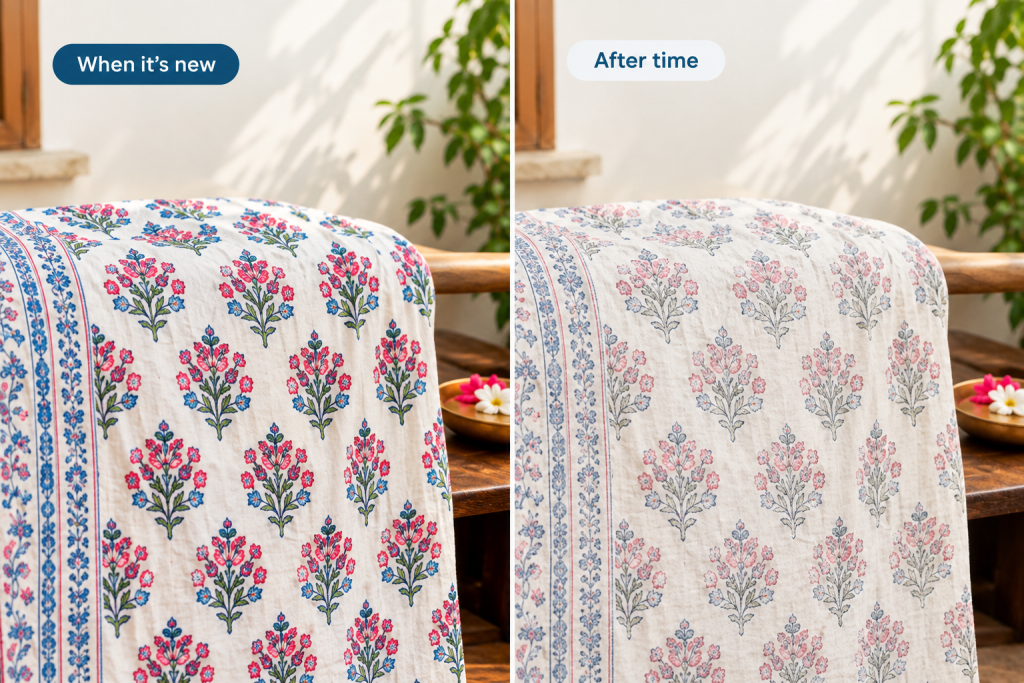
One hot wash. That’s all it takes to dull a hand block print bedsheet.
Not because the dye is weak. Because the first wash was too hot, too harsh, or too rushed.
Here’s the rule that saves almost every sheet: cold water, mild detergent, shade-dry. That’s it.
Everything below is just that rule, unpacked for your machine, your climate, and your particular sheet.
A customer in London learned this the hard way. She ran her brand-new indigo-and-madder Sanganeri sheet through a 40°C “gentle” cycle with her towels. By the second spin, the indigo had bled into the white background.
Colors a printer spent three days layering by hand, dulled in nine minutes.
It’s the mistake almost everyone makes on the very first wash. And it’s completely avoidable.
Why Hand Block Print Colors Fade Faster Than You'd Expect (And It's Not the Fabric's Fault)
Block print isn’t woven in color. It’s printed on top of the cotton.
The dye sits on the fiber’s surface, not running through it like a solution-dyed synthetic would. That’s what gives block print its soft, slightly uneven, hand-crafted look.
It’s also why it needs gentler care than a mass-printed sheet from a big-box store.
Natural vs. Azo-Free Synthetic Dyes: What's Actually on Your Sheet
Genuine Sanganeri work, sometimes called “jaipuri” print after the Jaipur region it comes from, uses one of two dye families.
Natural dyes come from indigo, madder root, pomegranate rind, and turmeric. They soften beautifully with age. But they’re also the most sensitive to heat and harsh chemicals.
Azo-free synthetic dyes are a safer, modern alternative to the banned azo dyes once common in cheap block printing.
More colorfast than natural dyes, but still nowhere near as tough as a machine-printed polycotton sheet.
If your care tag doesn’t specify which one you have, treat it as naturally dyed. It’s the safer bet either way.
The Real Culprits: Heat, Harsh Detergent, Direct Sun, Friction
Four things cause almost all the damage:
- Hot water opens the fiber and lets dye molecules escape
- Bleach and optical brighteners are formulated to strip color, not protect it
- Direct sunlight breaks down dye pigment over repeated exposure, the same way a shop-window poster fades over months in the sun
- Friction from tumbling with heavier fabrics like denim or towels wears the print down
Respect those four, and a block print bedsheet can easily outlast a mass-printed one. The dye just asks for a bit more care in exchange for a lot more character.
The First Wash Matters Most: Do This Before You Use It
Why You Should Wash Before First Use
Every hand block print sheet carries a little loose surface dye and starching residue left over from printing.
Wash it before it ever touches the bed. That lets the excess rinse away in a controlled way, instead of transferring onto your pillowcase (or your partner’s white T-shirt) on night one.
The Cold-Water Rule for Wash #1
For that first wash, use cold water only; think 20 to 30°C (68 to 86°F), basically straight from the tap in most climates.
Cold water is far less likely to loosen the dye that’s meant to stay put. It still rinses away what’s meant to come off.
Skip detergent entirely for this first rinse if you can, or use the smallest possible amount of a mild one. Think of it as the sheet’s “settling in” wash, not a real clean.
Machine Wash or Hand Wash

Machine Wash Instructions
- Turn the sheet inside out to reduce friction on the printed side.
- Use the gentle or delicate cycle only. Never use “normal” or “heavy duty.”
- Set the water temperature to cold, the same 20 to 30°C (68 to 86°F) range as the first wash. Avoid anything above 30°C (86°F).
- Wash it alone, or with other block prints or dark cottons of a similar color family. Never with towels, denim, or anything that sheds lint or dye.
- Use a mesh laundry bag if your machine has an aggressive drum. It cuts down on the tugging that wears at printed edges.
- Spin on the lowest setting available. A high-speed spin is unnecessary stress on the fibers.
Hand Wash Instructions
For readers without machine access, or who simply prefer hand-washing (a common habit across Indian metros), it’s just as simple:
- Fill a tub or bucket with cold water, at the same temperature as above.
- Dissolve a small amount of mild, pH-neutral detergent fully in the water before adding the sheet. Undissolved granules can bleach spots if they sit directly on the fabric.
- Submerge the sheet and swirl gently by hand for 3 to 5 minutes. Don’t scrub, twist, or wring.
- Rinse in fresh cold water until it runs clear. Two to three changes of water is normal.
- Press out excess water gently between two towels rather than wringing.
Detergent Matters More Than You Think
What to Use
Reach for a pH-neutral or mild detergent. The kind sold for wool, silk, or “delicates” often works beautifully on cotton block print too.
These formulas skip the aggressive whitening agents that are the real threat to color.
What to Avoid (Even When the Label Says "Gentle")
Skip chlorine bleach, obviously.
But also skip optical brighteners. They’re added to make whites look whiter by depositing a fluorescent coating, often at the cost of dulling colored prints over time.
Many detergents labeled “gentle” for marketing purposes still contain brighteners or stain-fighting enzymes that are harsher on natural dye than the label suggests.
Check the ingredient list, not the front-of-pack claim. Or look for detergents made specifically for hand-dyed or naturally dyed textiles.
Drying Without Killing the Colors
Shade-Dry vs. Direct Sun

This is where the real damage happens, even after a perfect wash.
Direct sunlight is a slow bleach. UV rays break down dye pigment over repeated exposure, and a sheet left flat in strong midday sun can visibly lighten after just a few dry cycles.
Dry in full shade. Outdoors for airflow is ideal, just out of direct light. Or indoors near an open window.
In humid, monsoon-season conditions common across Indian metros, prioritize airflow over speed. A fan-assisted indoor dry beats a rushed sun-dry, and it avoids the musty smell that comes from lingering dampness.
Machine Dryer Verdict
Short answer: avoid it, or use low heat only if you must.
Tumble drying combines two of the four culprits above — heat and friction — in one step.
If a dryer is unavoidable, use the lowest heat or “air only” setting, and pull the sheet out while still slightly damp.
Ironing, Storing & Everyday Habits That Protect the Print
Iron on Reverse, Medium Heat
Always iron from the back, on medium heat, ideally while the sheet is still slightly damp.
Ironing the printed side directly, especially on high heat, can flatten the texture of the dye and dull its finish over time.
Storage Tips
Store washed, fully dried sheets folded in breathable cotton bags, not sealed plastic.
Keep them away from direct light to prevent both fading and mildew in humid storage.
For more on rotating and storing seasonal linens, see our guide on caring for your razai and dohar collection between seasons.
Common Mistakes That Fade Block Print Bedsheets Fast
- Washing a brand-new sheet in hot water before its first cold “settling” wash
- Tossing it in the machine with towels, denim, or anything that sheds
- Using a detergent with bleach or optical brighteners
- Line-drying flat in direct, all-day sun
- Wringing the fabric hard instead of pressing out water
- Ironing directly on the printed side at high heat
- Letting it sit damp for hours in humid weather before drying fully
Frequently Asked Questions
Can I wash hand block print bedsheets in a washing machine? Yes. Use the gentle or delicate cycle, cold water (20 to 30°C / 68 to 86°F), and wash the sheet alone or with similar colors. Avoid hot water, high spin speeds, and mixing with towels or denim.
Why did my block print bedsheet bleed color in the first wash? Some loose surface dye is normal on a new sheet and is meant to rinse away in the first cold wash. Heavy or ongoing bleeding usually means the water was too hot or the detergent too harsh. Always do a cold, detergent-light first wash before regular use.
Is it normal for hand block print sheets to fade a little over time? Yes. Gradual, gentle softening of color is normal, even desirable, similar to well-loved denim. Sudden or patchy fading usually points to hot water, sun-drying, or a harsh detergent rather than normal wear.
What temperature water should I use to wash block print cotton? Cold water, ideally 20 to 30°C (68 to 86°F), for every wash, not just the first. Anything warmer than 30°C (86°F) risks loosening dye that’s meant to stay locked in.
Can I put block print bedsheets in the dryer? Best avoided. Heat and tumbling friction are two of the main causes of fading. If a dryer is unavoidable, use the lowest heat setting and pull the sheet out while still damp.
How do I stop natural dye bedsheets from fading in the sun? Dry in full shade, never direct sunlight, and store away from sun-facing windows. UV exposure breaks down dye pigment over time, so a shaded, airy spot is always safer than direct sun.
Can I wash a jaipuri bedsheet with other clothes? Safest to wash it alone, or only with other similarly dark, colorfast cottons. Towels, denim, and lighter fabrics risk lint transfer, dye bleeding, and extra friction.
How often should I wash an Indian hand block print bedsheet? Once a week works for most households, adjusted for climate. Wash more often in humid or high-heat monsoon conditions, less often if used with a duvet cover. Frequent gentle cold washes beat occasional hot ones.
Ready to bring one home?
Now that you know how to keep the colors sharp wash after wash, explore our Sanganeri Bedsheets collection, every piece hand-printed and cold-wash tested.

Textile writer and craft historian based in Jaipur, documenting India's living block-print traditions.