
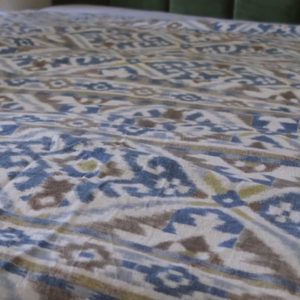
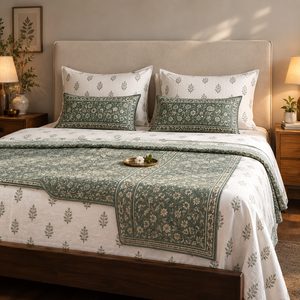
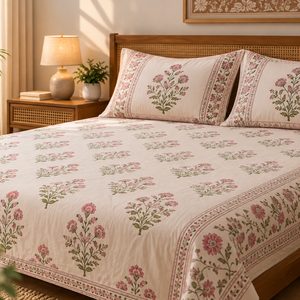
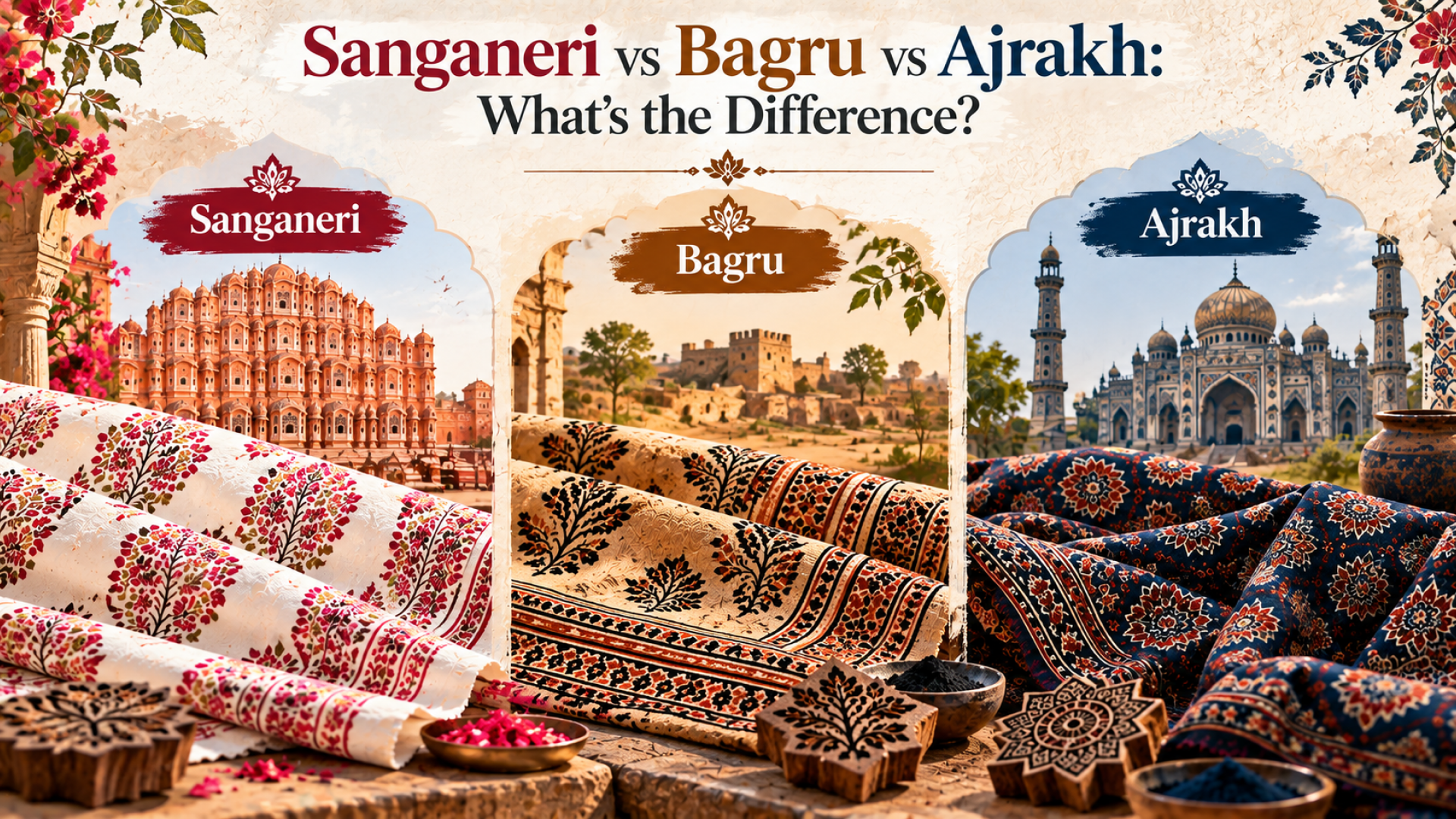
If you ever looked at an Indian block-printed cloth and wondered, “Is this Sanganeri, Ajrakh, or Bagru?”
Yes, most people do!
All three are Indian fabric printing traditions, but they aren’t identical.
They are specific to a region, use distinct colours and motifs, and employ unique printing methods.
You can easily tell them apart if you know where they come from, how they’re printed, and what makes each one look unique.
Sanganeri vs Bagru vs Ajrakh at a Glance
Sanganeri and Bagru are both registered GI handicrafts associated with Rajasthan. Kutch Ajrakh is separately registered as a GI from Gujarat.
Important: Ajrakh is not limited to Gujarat. Rajasthan’s official handicrafts portal also documents Ajrakh printing in Barmer, while Kutch Ajrakh has its own GI identity in Gujarat.
What Is Sanganeri Block Printing?
Sanganeri is a traditional hand block printing craft associated with Sanganer near Jaipur, Rajasthan.
The craft is officially registered as Sanganeri Hand Block Printing under India’s Geographical Indications system. The GI registration identifies Sanganer in Jaipur, Rajasthan, as the geographical area.
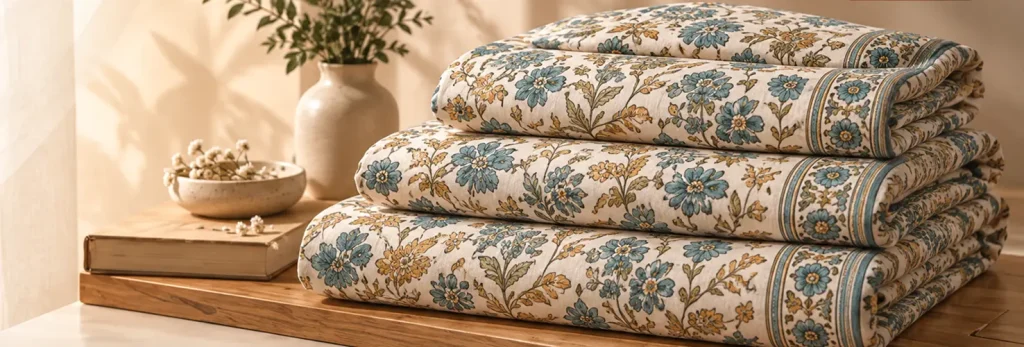
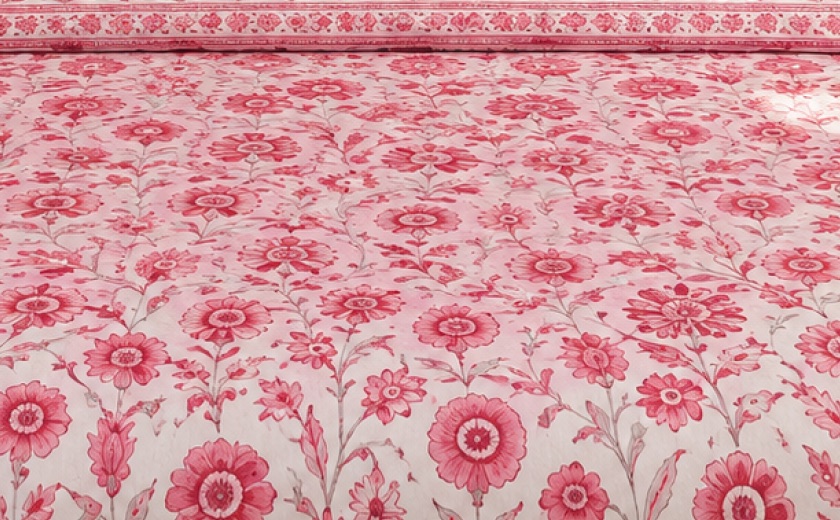
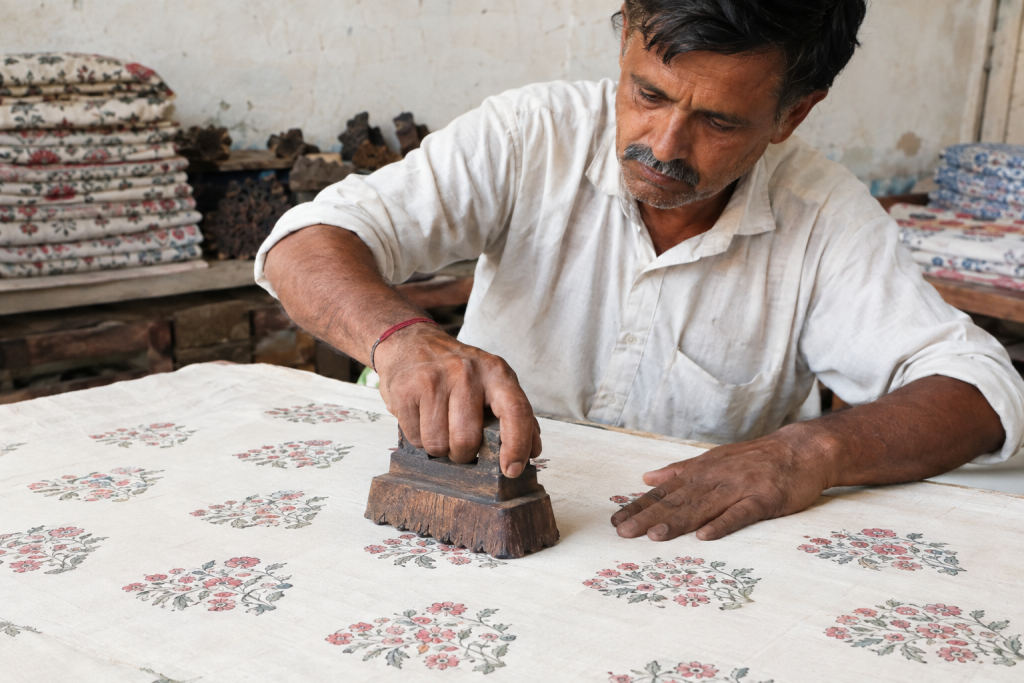
The easiest visual clue is the light or white ground combined with fine floral designs.
The GI documentation and related historical material describe Sanganeri printing as being associated with floral motifs and white-ground fabrics. A documented study also notes that Sanganeri prints are mostly on a white ground.
What Makes Sanganeri Different?
Sanganeri’s strongest identifier is not simply that it is colourful or floral.
It is the combination of fine floral design, a light or white ground and careful block placement.
Traditional Sanganeri designs can include small floral butis, larger butas, vines and other botanical forms. Historical documentation also describes the skill involved in aligning different blocks and colours across the fabric.
Another useful clue is the reverse side of the cloth.
In traditional Sanganeri printing, the design can remain clearly visible on the reverse because the printing process transfers colour into the fabric rather than leaving a purely surface-level image. The GI documentation and historical material describe this two-sided printing characteristic.
This does not mean that looking at the reverse alone can prove GI origin. It is a useful visual clue, not a certification test.
What Is Bagru Block Printing?
Bagru is a traditional hand block printing craft associated with Bagru near Jaipur in Rajasthan.
Bagru Hand Block Print is registered as a GI handicraft in India, with Bagru in Jaipur district identified in the GI record.
Bagru is where the comparison becomes more interesting because it includes both direct block printing and Dabu mud-resist printing.
That distinction is important.
Not every Bagru textile is Dabu, but Dabu is one of the techniques strongly associated with Bagru printing.
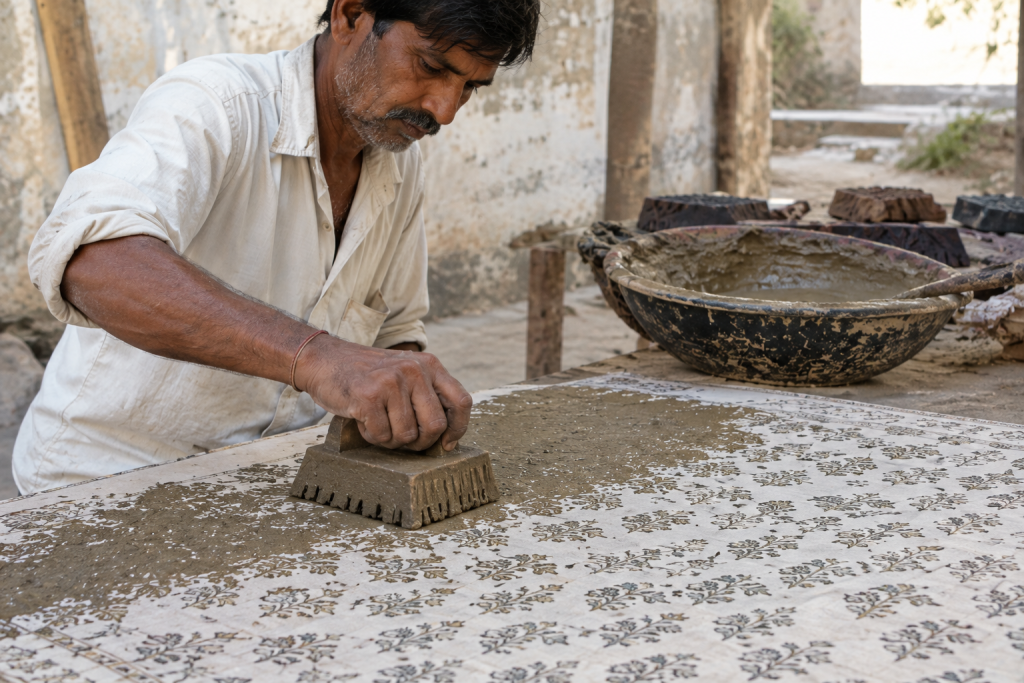
What Is Dabu Printing?
Dabu is a mud-resist technique.
Instead of putting colour everywhere the block touches, the artisan uses a resist paste to protect selected areas of the fabric from the dye.
The protected areas remain lighter after dyeing, creating the characteristic contrast between the dyed background and the resisted motif.
Government handicrafts documentation confirms that Bagru printing uses both direct and Dabu resist techniques. It also describes the preparation of the fabric with harda before printing and the use of successive block impressions.
Traditional Dabu paste is made from locally available materials, with documented descriptions including black clay, lime, wheat chaff, and gum. The exact preparation can vary between printing communities and workshops.
This is one of the most important clues for understanding Bagru.
Bagru is not simply “another hand block print.” Its Dabu tradition gives it a distinct resist-printing identity.
What Colours and Motifs Are Common in Bagru?
Bagru is strongly associated with earthy colours.
Government handicraft documentation lists colours including black, red, brown, grey, indigo and yellow. It also records floral motifs such as gainda, gulab, badaam and kamal, along with bel and smaller jaali patterns.
This gives Bagru a more grounded visual character than the fine white-ground look commonly associated with Sanganeri.
Bagru is also used for a wide range of textiles and products, including bedspreads, cushion covers and razai, as well as garments and accessories.
What Is Ajrakh Printing?
Ajrakh is a traditional resist-printing and dyeing tradition with historical roots in Sindh and important centres in Kutch, Gujarat, and Barmer, Rajasthan.
The Government of Rajasthan specifically identifies Ajrakh printing in Sindh, Kutch and Barmer. It describes traditional Ajrakh as a block-printed textile with deep crimson red and indigo blue backgrounds and symmetrical patterns.
Kutch Ajrakh has its own GI registration as a textile from Gujarat.
So the accurate way to describe Ajrakh is not “a Rajasthan craft” or “a Gujarat craft” alone.
It is better to say that Ajrakh has historical and contemporary traditions across the wider Sindh, Kutch, and Barmer region, with Kutch Ajrakh recognised separately under a Gujarat GI.
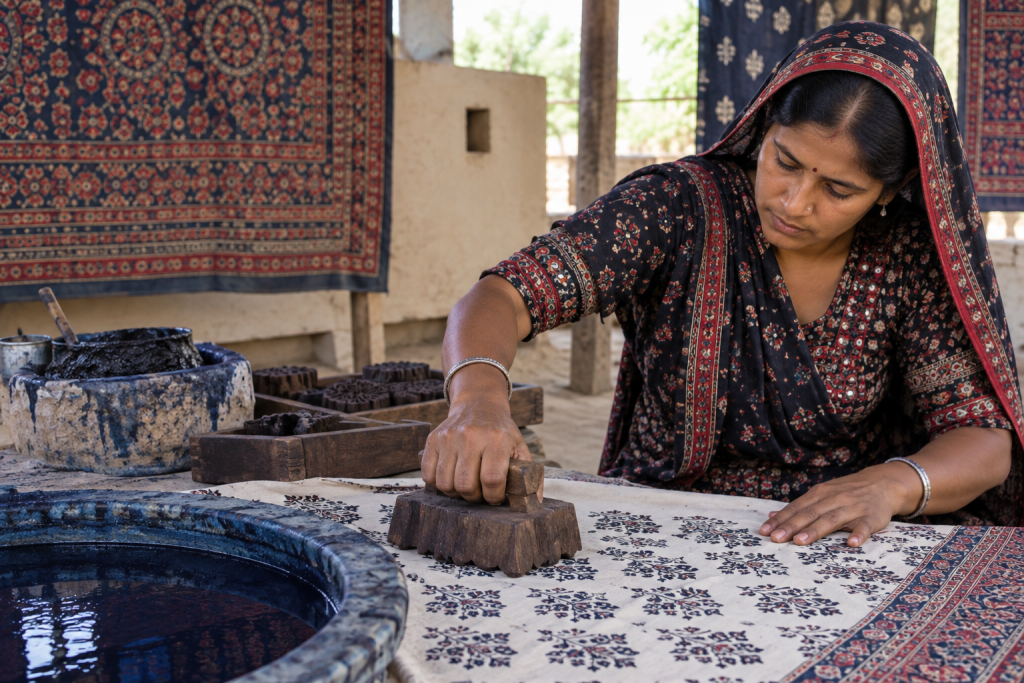
The Government of India’s handicrafts portal provides documented Ajrakh images and process information that can be used as a visual reference.
What Makes Ajrakh Different?
Ajrakh’s strongest visual clues are deep indigo, red, black and white combined with geometric symmetry.
The Government of India describes Ajrakh as using natural dyes such as indigo, Indian madder and alizarin, with resist agents including gum Arabic, red clay and tamarind seed powder.
The process is also more involved than simply pressing a coloured block onto fabric.
Government documentation describes Ajrakh as involving 14 stages, including washing, harda mordanting, resist printing, dyeing, repeated printing and washing.
That number is useful because it shows the complexity of the documented traditional process.
However, it should not be used to claim that every contemporary Ajrakh product follows exactly 14 stages.
Bagru vs Ajrakh: Why Are They So Easy to Confuse?
This is one of the most useful questions in the entire article.
Bagru and Ajrakh can both use indigo, red, black and resist techniques.
The difference is in the way those techniques are combined and the visual language that results.
Bagru
Bagru can use direct block printing or Dabu mud resist.
Dabu protects parts of the fabric from the dye, creating lighter motifs against a dyed ground.
Ajrakh
Ajrakh uses a more elaborate sequence of resist printing and dyeing.
Its strong geometric symmetry, repeated patterns and deep indigo-red-black palette are particularly distinctive.
The simple way to remember it
Bagru: think earthy colours + block printing + Dabu mud resist.
Ajrakh: think deep indigo + red + geometric symmetry + repeated resist dyeing.
They can overlap visually, but the processes and design traditions are not identical.
Sanganeri vs Bagru vs Ajrakh: The Real Difference in Technique
This is where the three traditions should be separated clearly.
Sanganeri
Look for:
- Fine floral motifs
- White or light ground
- Carefully aligned colour blocks
- Detailed botanical designs
- Pattern visible through the fabric on the reverse in traditional examples
Historical GI documentation describes the skill involved in printing different colours with separate blocks and maintaining accurate placement.
Bagru
Look for:
- Direct block printing
- Dabu mud-resist printing
- Earthy black, red, brown and indigo tones
- Floral butis and butas
- Strong nature-inspired motifs
- Resist areas that remain lighter after dyeing
Government craft documentation specifically identifies both direct and Dabu techniques in Bagru.
Ajrakh
Look for:
- Resist printing
- Repeated dyeing and printing
- Deep indigo
- Rich red
- Black and white contrast
- Geometric symmetry
- Multiple stages of preparation and dyeing
The Government of India documents a 14-stage traditional Ajrakh process and identifies indigo, madder, and alizarin among its important dyes.
Sanganeri vs Bagru vs Ajrakh
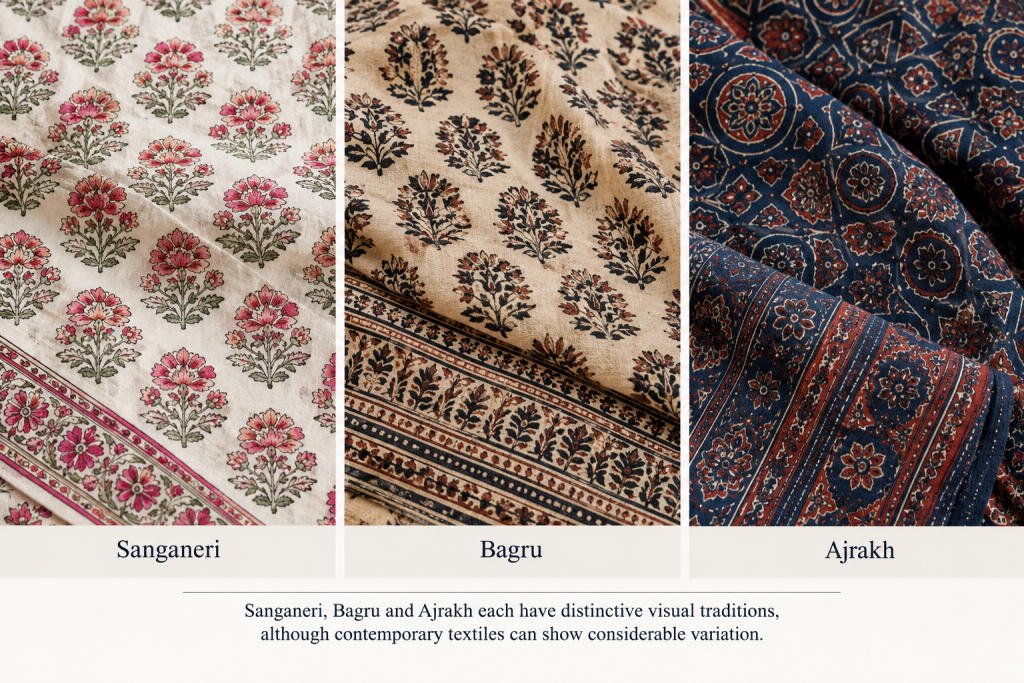
How to Tell Sanganeri, Bagru and Ajrakh Apart
If you are looking at a textile and need a quick starting point, use these clues.
If it has a white or light ground with fine floral motifs
Think Sanganeri first.
Look closely at the floral details and the reverse side of the cloth.
The GI documentation and historical material make the white ground and delicate floral character particularly useful identifiers.
If it has earthy colours and visible resist-style motifs
Think Bagru.
Look for black, red, brown or indigo tones and ask whether Dabu mud resist has been used.
If it has deep indigo, red, black and strong geometric symmetry
Think Ajrakh.
Then look for evidence of resist printing and repeated dyeing.
These are identification clues, not substitutes for documented provenance.
How to Spot a Screen-Printed Imitation
The word “hand block” is widely used in textile marketing, so it is worth checking what you are actually buying.
First, turn the fabric over.
In traditional block printing, colour can penetrate into the fabric, so the design may remain visible on the reverse. A screen or surface print can appear much more uniform and concentrated on the face of the fabric.
Next, examine the repeat.
Hand printing can show small variations in alignment, pressure and colour. A perfectly uniform repeat does not automatically mean a fabric is machine printed, but it is worth asking the seller how the textile was produced.
Finally, ask a direct question:
“Is this hand block printed, screen printed or digitally printed?”
A transparent seller should be able to answer.
What About Colour Bleeding?
Some hand-printed textiles can release excess surface dye during the first few washes.
This does not automatically mean the textile is poorly made.
The actual behaviour depends on the dye, fabric, finishing process and washing method.
Before buying, check the care instructions.
For dark indigo, red or other strongly dyed textiles, washing the first few times separately can be a sensible precaution unless the maker gives different instructions.
What Fabrics and Products Are Common?
These traditions are not limited to one type of clothing.
Bagru is documented on cotton and other fabrics and has historically been used for garments and household textiles such as bedspreads, cushion covers and razai.
Ajrakh is traditionally associated with cotton and is now used for garments, scarves, stoles and home products such as cushion covers, table runners and bedspreads.
Sanganeri is also widely encountered on cotton home textiles and apparel.
For buyers, the fabric itself matters just as much as the print.
A beautiful block print on a fabric that does not suit the intended use may not be the right choice.
What Does a GI Tag Mean?
A Geographical Indication, or GI, identifies goods associated with a particular geographical origin and specific qualities, reputation or characteristics connected with that origin.
For this article, three relevant GI registrations are:
Sanganeri Hand Block Printing: Rajasthan.
Bagru Hand Block Print: Rajasthan.
Kutch Ajrakh Print: Gujarat.
If a product is not actually made within the relevant GI geographical area or does not meet the applicable specifications, sellers should not casually use the GI name simply because the pattern looks similar.
For your own product pages, use terms such as “Sanganeri-inspired” only when appropriate, and reserve GI names for products that genuinely meet the relevant requirements.
Which Is Better: Sanganeri, Bagru or Ajrakh?
There is no universal winner.
The right choice depends on the look and feel you want.
Choose Sanganeri if you like:
- Fine floral patterns
- Light or white backgrounds
- Delicate botanical details
- A refined visual style
Choose Bagru if you like:
- Earthy colours
- Stronger floral motifs
- Dabu mud-resist effects
- Rustic, grounded patterns
Choose Ajrakh if you like:
- Deep indigo
- Rich red and black
- Geometric symmetry
- Layered resist-dyeing patterns
The best choice is the one that suits your personal taste, intended use, and preference for a particular craft tradition.
Sanganeri, Bagru and Ajrakh for Home Decor
These traditions work especially well in home textiles because their patterns can change the character of a room without requiring a complete redesign.
Sanganeri works naturally with lighter bedrooms and floral interiors.
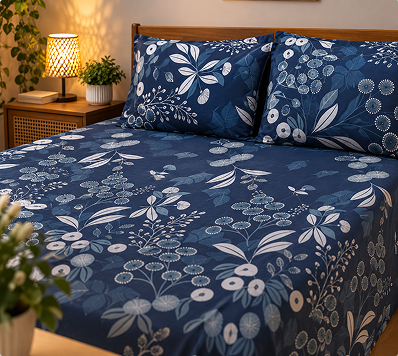
Bagru suits earthy, relaxed spaces where stronger patterns and warmer tones work well.
Ajrakh can create a broader visual accent through indigo, red, black, and geometric patterns.
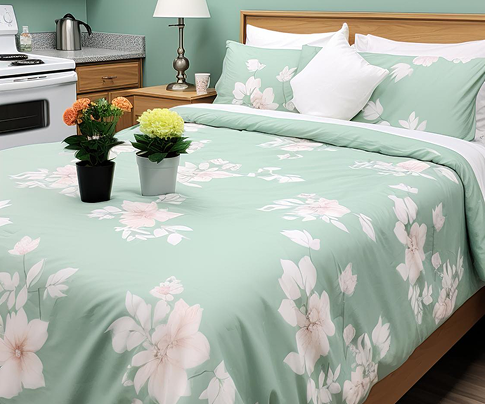
For a bedroom, you might use a Sanganeri-inspired bedsheet with plain cushions.
For a more earthy room, Bagru can work with natural wood and neutral fabrics.
For a stronger statement, Ajrakh can be used through cushions, throws, bedspreads, or smaller accent pieces.
How to Buy Authentic Hand Block Printed Textiles
Before buying, ask these five questions:
1. Where was it made?
Ask for the production location.
2. How was it printed?
Find out whether it was hand block printed, screen printed, or digitally printed.
3. What fabric is used?
Cotton, mulmul, voile, and other fabrics can behave differently during printing and washing.
4. What dyes were used?
Do not assume that every hand-block printed textile uses natural dyes.
Ask specifically if this matters to you.
5. How should it be washed?
Follow the maker’s care instructions, especially for dark colours and natural-dye textiles.
A transparent product description is one of the strongest signs that a seller understands what they are selling.
Frequently Asked Questions
What is the difference between Sanganeri and Bagru?
Sanganeri is best known for fine floral designs on a light or white ground, while Bagru is associated with earthy colours, stronger motifs and both direct block printing and Dabu mud-resist printing.
Is Ajrakh the same as Bagru?
No. Both can use resist printing and similar colours, but Ajrakh has its own design and dyeing tradition, with strong geometric symmetry and deep indigo-red-black colours. Bagru has its own direct-printing and Dabu traditions.
Is Sanganeri hand block printed?
Yes. Sanganeri Hand Block Printing is a registered GI handicraft associated with Sanganer in Rajasthan.
What is Sanganeri print famous for?
Sanganeri is particularly known for fine floral motifs on white or light-coloured grounds and detailed hand block printing.
What is Bagru print famous for?
Bagru is known for traditional hand block printing, earthy colours, floral and nature-inspired motifs, and Dabu mud-resist printing.
What is Ajrakh print famous for?
Ajrakh is known for deep indigo and red colours, geometric symmetry and a multi-stage resist-printing and dyeing process.
Is Ajrakh from Rajasthan or Gujarat?
Both regions have Ajrakh traditions. Rajasthan’s official handicrafts portal documents Ajrakh in Barmer, while Kutch Ajrakh has a separate GI registration in Gujarat.
What is Dabu in Bagru printing?
Dabu is a mud-resist technique. A resist paste is printed onto selected areas of the fabric so that the dye cannot reach those areas. After dyeing and washing, the protected areas form the lighter parts of the design.
How can I tell if a textile is hand block printed?
Check the printing method stated by the seller, examine the reverse side, and look for small variations in block alignment and pressure.
These clues can help, but they cannot independently prove provenance or GI status.
Do hand block printed fabrics bleed colour?
Some textiles can release excess surface dye during early washes, particularly strongly coloured fabrics. Follow the manufacturer’s care instructions and ask about washing requirements before purchase.
Is every Sanganeri, Bagru or Ajrakh product handmade?
No. A product name alone does not prove how it was manufactured.
Ask whether the fabric was hand block printed, screen printed, or digitally printed, and look for transparent information about its production.
Explore Hand Block Printed Textiles
To bring traditional Indian printing into your home, explore our collections of hand-block-printed textiles.

Textile writer and craft historian based in Jaipur, documenting India's living block-print traditions.